Comparing Sliding vs. Folding Doors: Which is Right for Your Patio?
MC
Author
2026-09-18
Published
9 min read
Reading time
Choosing the right door for your patio is one of the most consequential decisions in a modern home renovation. In Australia, where indoor-outdoor living is central to the way we design and build, the two systems most often shortlisted are sliding doors and folding (bi-fold) doors. Both connect your living space with the garden, pool or alfresco area, but they behave very differently once installed — in how much of the opening they can clear, how much floor space they consume, how they perform in wind and rain, and how they affect the overall look of your facade.
This guide compares sliding and folding patio doors in detail: design, performance, cost and suitability for different home layouts. It also covers what to look for in slimline folding doors in Australia, the Australian standards that apply, and how to choose a system that is genuinely certified for local conditions.
How Sliding Patio Doors Work
Sliding patio doors consist of two or more panels that glide on tracks, with at least one panel fixed while the others slide past it. A typical four-panel configuration provides a two-panel opening, while larger multi-panel or stacker systems fold and stack panels outside to create an even wider aperture.
Key characteristics of sliding doors:
- Operate on a top-track (or top-and-bottom track) system.
- At least one panel remains fixed at any time, so the maximum opening is roughly half the total door width (more with stacker configurations).
- Do not swing or fold, so they use minimal interior or exterior floor space.
- Well suited to long, straight openings and full-height glazed walls.
- Available in single-leaf, double-leaf and multi-panel configurations.
Because only part of the opening moves, sliding doors are often specified where the aperture is wide (four to six metres or more) and full-width access is not required. High-performance examples include Meichen’s Ultra Slim Coastal SD205-AS960 sliding/stacker system, rated to 960 Pa water tightness under AS4284, and the MC140 thermal break sliding door, which pairs slim aluminium profiles with an insulating break for improved energy performance.
How Folding Patio Doors Work
Folding doors — commonly called bi-fold or bifolding doors — consist of a series of hinged panels, typically three to six, that fold accordion-style to one side (or both sides) of the opening. When fully open, all but the final panel stack compactly at the end of the frame.
Key characteristics of folding doors:
- Multiple hinged panels fold to one or both sides.
- Can open 70 to 80% of the total aperture, providing near-complete indoor-outdoor access.
- Excellent for creating one continuous, uninterrupted living space.
- Require clear wall space at the end(s) of the opening for the stacked panels.
- Ideal for medium to large openings, typically 2.4 m to 6 m wide.
Folding systems are the go-to choice for patios, decks and courtyards where a fully openable wall is the goal. For a premium look, mullion-free designs remove the vertical sight lines between panels, so the glass reads as one continuous sheet. Meichen’s MA73 bi-fold door is a thermal break system offered with a no-mullion option, built for homeowners who want maximum glass and minimal frame.
Sliding vs. Folding: Head-to-Head Comparison
The table below summarises the main differences to weigh up before choosing:
| Consideration | Sliding Doors | Folding Doors |
|---|---|---|
| Maximum opening width | ~50% (more with stacker systems) | 70–80% |
| Indoor/outdoor footprint | Minimal — panels run inside the frame line | Panel stack needed at one or both ends |
| Indoor-outdoor flow | Good | Excellent |
| View obstruction | Fixed + sliding panels overlap slightly | Minimal with mullion-free designs |
| Wind & rain performance | Very good (fewer open edges) | Good when fully closed |
| Security | High (fewer operable edges) | Moderate (more hinges and joints) |
| Maintenance | Low (tracks and rollers) | Moderate (hinges and hardware checks) |
| Typical applications | Wide openings, high-rise, coastal sites | Alfresco, pool, courtyard, feature walls |
Space and Layout: Which Door Fits Your Patio?
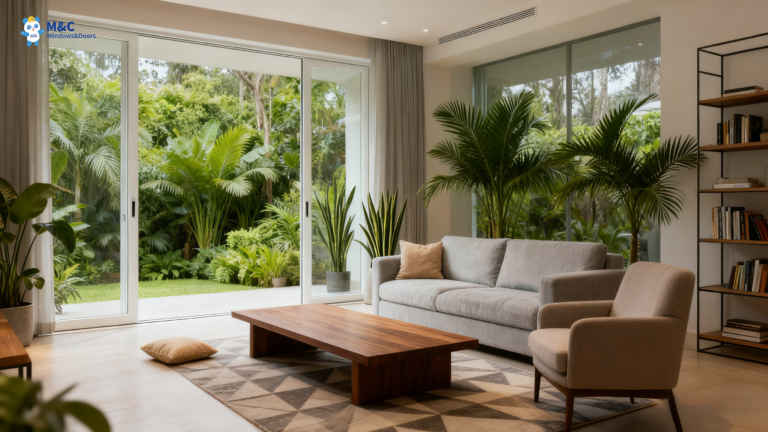
Layout is often the deciding factor. Sliding doors suit wide, straight openings where the goal is to keep the door completely out of the way. Because the panels run within the frame line, sliding doors work well on narrow verandas, high-rise balconies and coastal sites where there may be no room for panels to stack outside the building envelope.
Folding doors need clear floor space at the end of the opening where the panels stack when open. If your patio is long and narrow, or if outdoor furniture sits directly against the wall, make sure the stacked panels will not become an obstacle. As a rule of thumb, each 900 mm panel takes up roughly 150–200 mm of wall when stacked, so a 5.4 m four-panel opening needs about 0.6–0.8 m of clear space on one side.
If you want to erase the wall entirely — dining table under the pergola, sofa facing the garden — a folding door will usually deliver a larger usable opening than a sliding door of the same width.
Aesthetics and Slim Profiles: The View Factor
Modern Australian architecture favours big glass and minimal frames. Both door types have evolved to meet that demand, but they approach it differently.
Sliding doors achieve slimness through narrow stiles and refined tracks. High-end systems now use profiles only a few centimetres wide, with floor-to-ceiling glass that makes the frame nearly disappear. The trade-off is that at least one panel always overlaps another in the closed position, creating a subtle but visible sight line across the opening.
Folding doors achieve slimness differently: mullion-free hinge designs remove the vertical bars between panels, so an open wall reads as one continuous sheet of glass. That is why slimline folding doors in Australia have become popular in luxury villas, architect-designed homes and high-end apartments where uninterrupted views are a priority.
When comparing aesthetics, look at:
- Profile depth and sight line — narrower is better for large glass areas.
- Mullion design — mullion-free hardware hides the panel divisions.
- Colour and finish options — powder coating in custom RAL colours, including classic pearl white.
- Hardware visibility — recessed handles and concealed hinges look cleaner.
Meichen’s ultra-slim frame systems — including the SD205-AS960 sliding/stacker door and the MA73 mullion-free bi-fold — are designed around exactly these principles: ultra-slim profiles, architectural aluminium 6063, and double or triple Low-E glazing for maximum daylight with a minimum of frame.
Energy Efficiency and Weather Performance in Australian Climates
Energy performance depends on the frame, the glazing and the seals — not just the door type. Both sliding and folding doors can be highly efficient when they use a thermal break frame, quality glazing and continuous gaskets.
Thermal break frames insert an insulating barrier between the interior and exterior of the aluminium profile, dramatically reducing heat transfer through the frame. Paired with double or triple Low-E glazing, thermal break doors support higher energy ratings and more comfortable interiors in both summer and winter. Meichen’s thermal break range, including the MA73 bi-fold door and the MC140 sliding door, uses precisely this approach.
Weather performance is where Australian standards become important. Windows and external doors installed in Australia must comply with:
- AS 2047 — Windows and doors
- AS 4284 — Performance of windows and external doors
- AS 1288 — Glazing in buildings
- AS 4666 — Installation of windows and external doors
- AS 2208 — Safety glazing in buildings
For coastal and high-rise sites, wind load and water penetration are the critical tests. Meichen’s systems are tested to water tightness performance of up to 960 Pa under AS4284 — a benchmark that sets a high bar in the industry — and are engineered for the high wind load resistance required in multi-residential developments.
In practice, a well-engineered sliding door with fewer operable edges often holds a slight advantage in weathertightness at very large widths, while a folding door with quality ANZ-specific hardware performs well at its typical sizes. Either way, insist on Australian test reports rather than generic marketing claims.
Security, Maintenance and Long-Term Durability
Security. Sliding doors generally offer stronger security at the same price point: there are fewer hinges to lift or defeat, and quality multi-point locking systems can engage across the full height of the door. Folding doors have more joints and hardware, so security depends heavily on hinge quality, lock configuration and anti-lift features. Specify security-rated hardware before choosing.
Maintenance. Both systems require periodic care. Sliding doors need clean, unobstructed tracks and occasional roller attention; a sticking panel is almost always a track issue. Folding doors need hinge checks and adjustment, especially on wider multi-panel configurations, because the weight of the stacked panels is carried by the pivot hardware.
Durability. Aluminium is the dominant frame material in Australia for a reason: it is corrosion-resistant, recyclable and does not rot or warp. The quality of the powder coat and the hardware determines how the door looks after ten years of sun and salt air. Choose ANZ-specific hardware, marine-grade finishes for coastal sites, and double or triple Low-E glass for long-term optical and thermal performance.
Cost: What Should You Budget?
Cost depends on width, height, panel count, glazing and hardware. As a general guide:
- Sliding doors are usually more affordable per square metre at equivalent widths, because they use fewer moving parts and simpler hardware.
- Folding doors cost more as panel count increases; each additional panel adds hinges, tracks and engineering.
- Mullion-free and thermal break specifications add to the cost of either type.
- High-performance glazing (triple Low-E, argon-filled) increases price but can pay back over time through energy savings.
Rather than comparing sticker prices, compare specifications: frame type (thermal break or not), water tightness class, wind load rating, glazing configuration and warranty terms. A cheaper door that fails in the first storm season is an expensive door.
When Sliding Doors Are the Better Choice
Choose sliding doors when:
- The opening is very wide (4 m or more) and you do not need full-width access.
- Space is tight — high-rise balconies, narrow verandas, or coastal sites with no room for panel stacking.
- Maximum weathertightness and security are your top priorities.
- You want the lowest-maintenance option of the two.
A high-performance sliding/stacker system gives you the best of both worlds: sliding operation day to day, with the ability to stack panels for the occasional full-width opening.
When Folding Doors Make Sense
Choose folding doors when:
- You want 70–80% of the opening fully clear.
- Indoor-outdoor flow is the priority: pool, alfresco dining, courtyard.
- The aperture is between 2.4 m and 6 m wide and you have room for the panel stack.
- You want a minimalist, mullion-free glass wall as a design feature.
Folding doors transform the way a room is used. On the right patio, they are the difference between a door and a threshold.
Slimline Folding Doors in Australia: What to Look For
If a folding door is your choice, here is a checklist for evaluating slimline folding doors Australia-wide, before you commit:
- Certification. Look for products tested to AS 2047 and AS 4284 with documentation to prove it. Meichen has 43 product series certified to Australian standards and 13 product lines certified to New Zealand standards (SNZ TS 4211:2022 and SNZ 4223), and is actively pursuing CodeMark certification — the highest level of third-party assessment available in Australia.
- Slim profiles with mullion-free options. Narrow stiles and concealed mullions are what make “slimline” more than a marketing term.
- Thermal break construction. Essential for comfort and energy efficiency, and required to get the best from premium glazing packages.
- ANZ-specific hardware. Hinges, locks and operators designed for Australian usage, security and building requirements — not generic imported hardware.
- Proven water and wind performance. Ask for the water tightness class (Pa) and wind load rating. Meichen’s systems are tested to up to 960 Pa under AS4284.
- Warranty and support. A 10-year warranty and local installation support matter more than the purchase price.
The Meichen Difference
Meichen International (MC Windows) has spent nearly two decades engineering high-performance aluminium window and door systems, and has been dedicated to the Australian and New Zealand market since 2017. The company operates a 20,000 sq m manufacturing facility, with a supply chain anchored by AAG aluminium (37 years of production) and CSG glass (42 years of automated glass production), plus ANZ-specific hardware refined over more than 10 years of local market experience.
For homeowners, architects and developers, that translates into:
- Slim profile systems that maximise glass and minimise frame.
- Thermal break designs paired with double and triple Low-E glazing.
- Products certified to Australian and New Zealand standards, with testing through recognised laboratories including NATA-accredited testing.
- Local partnership and installation support through Sydney, backed by direct factory capability.
Whether you are specifying for a luxury villa, a townhouse, a high-end apartment or a commercial development, a certified, locally supported system is the safest path to a patio door that performs for decades.
Frequently Asked Questions
Are folding doors more expensive than sliding doors?
Generally, yes. Folding doors use more panels and more hardware, so at the same opening width they tend to cost more than a sliding door. The gap narrows with multi-panel or stacker sliding systems. Compare width, glazing and hardware like-for-like before judging cost.
Which opens wider — sliding or folding?
Folding doors. A four-panel folding system can open roughly 75% of the aperture, while a standard four-panel sliding door opens about 50%. If full-width access is a priority, folding wins.
Are folding doors safe in strong winds?
Yes, when correctly specified and installed. Choose systems tested to AS 2047 and AS 4284 for wind load and water tightness, with ANZ-specific hinges and locking hardware. Meichen’s systems are rated to water pressures of up to 960 Pa under AS4284 and are engineered for high-rise wind loads.
Can folding doors be slimline and energy efficient at the same time?
Yes. Slim profiles and thermal break construction are not mutually exclusive. The right system combines narrow sight lines with an insulating frame break and Low-E double or triple glazing. Ask for the glazing specification and frame type in writing before ordering.
Which door type is easier to maintain?
Sliding doors. With fewer hinges and joints, sliding systems generally require less adjustment over time. Folding doors are straightforward to maintain provided the hinges are checked annually and the hardware is quality.
Do I need building approval for a new patio door?
Replacing a door within the same opening usually does not require approval, but structural changes — widening the opening, removing a load-bearing wall, or altering egress — typically do. Engage a licensed installer and confirm with your local council before starting.
Final Verdict
Sliding doors deliver the best combination of width, weathertightness, security and low maintenance — ideal for wide openings, high-rise sites and coastal homes. Folding doors offer something sliding cannot: a nearly fully openable wall that truly dissolves the boundary between inside and out.
For most Australian patios, the decision is not about which door is objectively better, but how you will use the space. If you want a wider opening, more glass and an uninterrupted view, certified slimline folding doors in Australia — with thermal break frames, mullion-free profiles and ANZ-specific hardware — are an outstanding choice.
Whichever type you choose, buy performance rather than price: Australian test reports, a proven manufacturer, local installation support and a long-term warranty are what keep your patio door performing for decades.
References & Standards
- Meichen International (MC Windows) — brand and product knowledge base, 2026. mcwindow.com.au
- Meichen Premium Brochure, Collection 2026 — MC-75A High-End Minimalist Series (architectural aluminium 6063, triple glazed Low-E, ISO 9001:2015 system, Class 8 test results).
- Meichen Windows & Doors Product Brochure — third-party test reports: air tightness, water tightness, wind resistance, sound insulation, thermal performance, fire rating.
- Standards Australia — AS 2047, Windows and doors.
- Standards Australia — AS 4284, Performance of windows and external doors.
- Standards Australia — AS 1288, Glazing in buildings.
- Standards Australia — AS 4666, Installation of windows and external doors.
- Standards Australia — AS 2208, Safety glazing in buildings.
- Standards New Zealand — SNZ TS 4211:2022 and SNZ 4223 (external window and door performance).
Related Articles
Optimal Airflow with Modern Design,Auckland Aluminium Louver Windows
The aluminium frames add to their durability, making them suitable for Auckland’s variable weather conditions,…
Gold Coast High-Rise Seaside Apartments: Why Window Selection Is More Complex Than It Looks
High-rise seaside apartments are among the most desirable residential properties on Australia’s Gold Coast. Floor-to-ceiling…
Thermal Break Aluminium Windows: A Practical Australian Selection Guide
Choosing a window system for an Australian home is rarely just about looks or price.…