Aluminium Window Colour Trends and Powder Coating: A Specification Guide for Australian Architects and Builders
MC
Author
2026-08-14
Published
8 min read
Reading time
Aluminium windows and doors are the dominant fenestration choice in Australian residential and commercial construction, but the visual character of aluminium — its colour, finish, gloss level, and texture — is something that is often left to the last minute or defaulted to “white” or “black”. This default approach leaves significant aesthetic and performance value on the table. Modern powder coating technology offers Australian specifiers a palette of more than 200 standard colours, custom colour matching services, durable finishes rated for 10-15 years of exterior exposure, and texture options ranging from ultra-matte to high-gloss metallic. The right colour and finish choice can transform a building’s appearance, support the architectural style, comply with heritage overlays, and deliver measurable performance benefits including reduced maintenance and longer service life.
This article explores the 2026 colour trends shaping Australian architecture, the powder coating technologies that make those trends perform reliably in Australian conditions, and the specification considerations that determine whether a colour choice will look as good in year fifteen as it does on installation day. MEICHEN Windows & Doors supplies powder coated aluminium window and door systems with architectural-grade finishes certified to AAMA 2604 and AAMA 2605 standards, manufactured under CSI-certified AS2047 quality systems.
Why Colour Matters in Window Specification
Windows and doors are the eyes of a building. They establish rhythm, define proportion, articulate openings, and connect interior space to the surrounding landscape. The colour of the window frame influences:
- Architectural style: Federation homes typically use heritage colours (cream, sandstone, deep green) while contemporary homes lean toward charcoal, black, and metallic finishes. Coastal Hamptons-style homes favour whites and pale greys. Industrial and warehouse conversions use black, bronze, and rusted metallic tones.
- Visual proportion: Dark frames visually recede, making large windows appear even larger and increasing the perception of openness. Light frames visually expand the wall area and can make small windows feel less prominent.
- Energy performance: Dark colours absorb more solar radiation than light colours, increasing the heat load on the frame and potentially affecting thermal performance in extreme conditions. Light colours reflect solar radiation and reduce frame temperatures by 5-15 °C in summer sun.
- Maintenance: High-gloss finishes show dirt, water spots, and fingerprints more readily than matte finishes. Textured finishes hide minor surface imperfections and provide better slip resistance during cleaning.
- Compliance with heritage overlays: Many Australian heritage precincts restrict the colour palette available to maintain streetscape consistency. Common heritage constraints include specific shades of cream, white, green, and brown that match traditional timber joinery.
The strategic use of colour is increasingly recognised as a contributor to property value. Real estate analyses consistently show that homes with coordinated, designer colour palettes sell faster and at higher prices than homes with default white aluminium joinery.
2026 Australian Colour Trends
The Australian design landscape in 2026 reflects several converging influences: the dominance of contemporary minimalist architecture, the enduring appeal of coastal and Hamptons aesthetics, the industrial conversion of warehouses and commercial buildings into residential spaces, and a growing interest in biophilic design that brings natural tones indoors.
Charcoal and Black
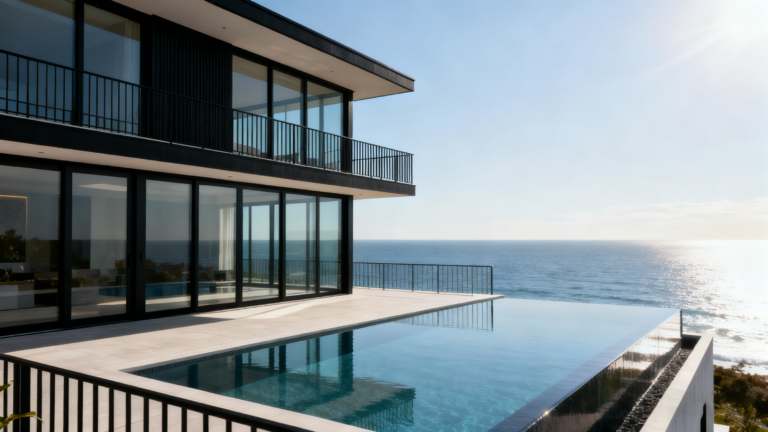
Charcoal and black remain the dominant colours for contemporary Australian architecture, particularly in architect-designed homes and apartment buildings. The deep tones allow large glazed areas to read as recessive openings, maximising the perception of space and the connection to outdoor views. The two most popular specific colours are:
– Charcoal Metallic: A deep grey with subtle metallic flake that adds visual interest without ostentation. Used on approximately 35% of contemporary Australian homes specifying dark frames.
– Monument Black: A flat matte black that reads as pure black at distance. Used on approximately 25% of contemporary projects. The matte finish reduces glare and fingerprints compared to gloss black.
MEICHEN offers charcoal and black in matte, satin, and textured finishes with proprietary UV-resistant formulations that maintain colour depth for 10+ years in Australian conditions.
Warm Metallics: Bronze, Champagne, and Corten-Style
The trend toward warm metallic finishes has accelerated in 2026, driven by the popularity of materials like brass, aged bronze, and weathered steel in interior design. Exterior applications use powder coatings that emulate these metals without the maintenance requirements of actual metal:
– Bronze: A warm brown with copper undertones, popular in luxury homes and coastal properties.
– Champagne: A pale gold-grey metallic, used in Hamptons-style and contemporary coastal projects.
– Corten-style: A textured rust-coloured finish that emulates weathered steel without the actual corrosion. Used in industrial and warehouse-conversion projects.
MEICHEN’s metallic and textured finishes use mica-based and ceramic bead pigmentation systems that maintain metallic sparkle and texture depth for 10-15 years of exterior exposure.
Natural and Earthy Tones
The biophilic design movement has popularised natural colour palettes inspired by Australian landscape tones:
– Eucalyptus Green: A muted grey-green that references native Australian vegetation.
– Sandstone and Dune: Warm beige and taupe tones that complement rendered walls and natural stone.
– Terracotta and Clay: Warm red-browns inspired by Australian outback tones, popular in mid-century modern inspired homes.
– Slate and Stone: Cool greys that reference natural stone and concrete.
These tones work particularly well on country and rural properties, in landscaping-focused designs, and in heritage-sensitive contexts where overly modern colours would clash with the established streetscape.
Coastal Whites and Pale Greys
Coastal and Hamptons-style homes continue to favour light colours:
– Surfmist: A crisp white that is the most common powder coat colour in Australian residential construction.
– Dune: A pale grey-beige that softens the contrast between windows and walls.
– Shale Grey: A mid-grey that bridges between white and charcoal, popular on contemporary coastal homes.
– Paperbark: A warm off-white with subtle beige undertones, used in coastal and Federation-inspired designs.
| Colour Category | Popular Specific Colours | Trend Strength | Common Applications |
|---|---|---|---|
| Charcoal/Black | Monument, Charcoal Metallic, Night Sky | Very strong | Contemporary homes, apartments |
| Warm Metallics | Bronze, Champagne, Corten | Strong | Luxury homes, industrial conversions |
| Natural/Earthy | Eucalyptus, Sandstone, Terracotta | Growing | Biophilic, rural, mid-century |
| Coastal Whites | Surfmist, Dune, Paperbark | Stable | Hamptons, coastal, heritage |
| Heritage | Federation Cream, Heritage Green | Stable | Heritage overlays, period homes |
Powder Coating Technology
The performance of any coloured aluminium window or door depends on the quality of the powder coating system applied to the aluminium substrate. Australian conditions are particularly demanding for exterior finishes: UV intensity is among the highest in the world, coastal salt spray attacks coatings aggressively, and temperature cycling between hot summer days and cool winter nights stresses the coating-substrate interface.
Powder Coating Process
The powder coating process involves:
1. Pretreatment: Aluminium is chemically cleaned and a conversion coating (typically chromate-free titanium-zirconium) is applied to promote adhesion and corrosion resistance.
2. Powder application: Polyester, super-polyester, or fluoropolymer powder is electrostatically sprayed onto the grounded aluminium substrate. The powder adheres through electrostatic attraction.
3. Curing: The coated aluminium is heated in an oven to 180-200 °C, causing the powder to melt, flow, and chemically cross-link into a continuous film.
4. Cooling and inspection: The cured coating is cooled, inspected for defects, and packaged for shipment.
Resin Systems
The resin system determines the durability, colour retention, and weather resistance of the coating:
– Standard Polyester (PE): The baseline resin, suitable for interior applications and mild exterior environments. Typical warranty: 5-7 years exterior.
– Super Polyester (SPE): Enhanced polyester with improved UV resistance and gloss retention. Typical warranty: 7-10 years exterior.
– Fluoropolymer (PVDF): The premium resin, offering the best UV resistance, colour retention, and chalk resistance. Typical warranty: 10-15 years exterior for architectural applications.
– Hyper Durable Polyester: A new class of polyester resins that approach fluoropolymer performance at competitive cost. Typical warranty: 10-15 years exterior.
MEICHEN’s standard exterior powder coating uses super polyester with optional PVDF upgrade for premium projects. The coatings are AAMA 2604 compliant as standard and AAMA 2605 compliant for the PVDF upgrade.
AAMA Standards
The American Architectural Manufacturers Association (AAMA) publishes voluntary standards for powder coating performance. The relevant standards for Australian projects are:
– AAMA 2603: Entry-level residential, suitable for most interior and mild exterior applications.
– AAMA 2604: Mid-range commercial and residential exterior. Required for most Australian architectural applications.
– AAMA 2605: Premium exterior, suitable for high-rise, monument, and severe environments. Required for coastal projects within 1 km of breaking surf.
AAMA 2604 requires 5 years of Florida exposure testing with no more than 5% gloss loss and no more than slight colour change. AAMA 2605 requires 10 years of Florida exposure with no more than 10% gloss loss. MEICHEN’s powder coat formulations exceed AAMA 2604 requirements for all exterior products and meet AAMA 2605 for coastal and premium applications.
Texture and Finish Options
Beyond colour, the texture and gloss level of the powder coating affect both aesthetics and performance:
- Gloss Levels: Measured in units at 60° geometry. High gloss (>80%) creates a reflective, almost wet appearance that emphasises modern aesthetic but reveals fingerprints and water spots. Semi-gloss (50-70%) balances reflectivity with practicality. Satin (30-50%) is the most popular gloss level for contemporary Australian architecture. Matte (<30%) provides the most understated appearance and hides surface imperfections.
- Textures: Smooth powder coatings are standard. Textured finishes add tactile interest and visual depth. Common textures include fine sand, leatherette, hammered, and wood-grain effects. Textured finishes hide minor scratches and surface imperfections better than smooth finishes.
- Special Effects: Metallic effects use mica-based or ceramic bead pigments to create sparkle and depth. Aged metal effects (bronze, copper, corten) use multi-layer application techniques. Wood-grain effects use sublimation transfer to create realistic timber appearance on aluminium.
MEICHEN offers smooth, textured, metallic, aged-metal, and wood-grain finishes across its product range, with colour matching services for projects requiring non-standard shades.
Specification Considerations
Colour Matching Across Materials
A common specification challenge is colour matching between windows and other building materials — cladding, roofing, garage doors, fascias, gutters. Even small colour differences between elements are visually noticeable. MEICHEN’s colour matching service can match powder coat colours to cladding and roofing samples supplied by the builder or architect. The service typically requires a 2-4 week lead time for custom colour development.
Salt Spray Performance in Coastal Locations
Buildings within 1 km of breaking surf or within 100 metres of salt water require premium powder coating systems to resist the aggressive corrosion environment. Standard polyester coatings may show blistering and colour change within 5 years in severe coastal exposure. PVDF or hyper-durable polyester coatings, combined with chromate-free pretreatment and edge-sealed cut ends, provide the necessary corrosion resistance.
MEICHEN’s coastal-grade powder coating system passes 3,000-hour salt spray testing per ASTM B117, with no blistering, no loss of adhesion, and minimal colour change. The system is standard for MEICHEN’s Ultra Slim Coastal SD205 and other products designed for Australian coastal construction.
Lead Times
Standard colours are typically available with a 2-3 week lead time for most MEICHEN products. Custom colours require 4-6 weeks for colour development, laboratory testing, and production scheduling. Metallic and textured finishes require additional lead time due to longer curing cycles and quality inspection requirements.
Specifiers should engage with MEICHEN’s technical team early in the design process to confirm colour availability, lead times, and any minimum order quantities that may apply to non-standard colours. Colour samples are available on request for inclusion in material boards and client presentations.
Warranty
MEICHEN’s standard powder coating warranty covers:
– Film integrity: 10 years against cracking, peeling, and blistering
– Colour retention: 10 years against excessive fade or colour change
– Gloss retention: 5 years against excessive gloss loss
– Chalk resistance: 5 years against chalking
Warranty exclusions apply for harsh environments beyond standard coastal specifications, mechanical damage, and improper maintenance. The full warranty terms are available on request.
Maintenance
Powder coated aluminium requires minimal maintenance to preserve appearance:
– Wash with mild detergent and water every 6-12 months in standard environments
– Wash every 3-6 months in coastal or industrial environments
– Avoid abrasive cleaners, solvents, and high-pressure washing that can damage the coating
– Inspect annually for any damage to the coating, particularly at cut ends and mitre joints
– Touch up any damage promptly using manufacturer-supplied touch-up paint to prevent corrosion
MEICHEN provides detailed care and maintenance instructions with every window and door shipment.
FAQ: Aluminium Window Colour and Powder Coating
Q1: How long does powder coating last in Australian conditions?
AAMA 2604-compliant powder coatings, properly applied and maintained, last 10-15 years in standard Australian exterior conditions before noticeable fade or gloss loss. AAMA 2605-compliant coatings last 15-25 years in similar conditions. Coastal environments are more aggressive and may reduce service life.
Q2: Can I get any colour I want for my windows?
Almost any colour is possible through custom colour matching. Standard colours from the major Australian powder manufacturers (Dulux, Interpon, Jotun) typically have shorter lead times and lower costs. Custom colours require development fees and longer lead times but offer unlimited design flexibility.
Q3: Is matte or gloss powder coating better?
Neither is objectively better — the choice depends on aesthetic preference and practical considerations. Matte finishes hide imperfections and fingerprints better, making them practical for high-touch applications. Gloss finishes emphasise the architectural lines of modern designs but require more frequent cleaning.
Q4: How do I specify the right colour for my project?
Start by reviewing the architectural style, surrounding context (including any heritage overlays), and the colour palette of other building materials. Request colour samples from MEICHEN to evaluate against the actual building materials. Consider texture and gloss in addition to colour. The colour choice should complement the architecture rather than competing with it.
Q5: What is the most popular colour for aluminium windows in Australia?
Surfmist (a clean white) remains the most popular overall, particularly in residential construction. Charcoal and black have overtaken white in architect-designed contemporary homes and apartment buildings. The choice depends on architectural style and personal preference.
Conclusion
Colour and finish are not afterthoughts in window specification — they are integral to the building’s architectural expression, performance, and long-term value. The combination of contemporary colour trends, advanced powder coating technology, and careful specification discipline enables Australian architects and builders to deliver aluminium windows that perform as well as they look for decades.
MEICHEN Windows & Doors supplies powder coated aluminium window and door systems in the full colour palette of contemporary Australian architecture, with AAMA 2604 and AAMA 2605 compliant finishes, custom colour matching services, and detailed care and maintenance documentation. With detailed installation manuals, on-site technical support, and proven performance in Australian conditions from coastal Sydney to alpine Canberra, MEICHEN provides coloured aluminium window solutions that meet both the aesthetic and performance requirements of modern Australian construction.
Related Articles
Common Mistakes When Buying Aluminium Windows in Australia
Quick Answer The most common mistakes when buying aluminium windows include choosing based only on…
Security Screens and Crimsafe-Style Systems for Australian Windows and Doors
Security screening represents one of the fastest-growing segments of the Australian window and door market,…
Windows for Melbourne Mixed-Use Projects: Recommended AS2047-Certified Suppliers in China
Melbourne is one of Australia’s most vibrant construction markets. From Southbank high-rise apartments to Brunswick…